Chemistry.
Chemistry is the study of everything material. What we eat, wear, drive, build and listen to is all affected by Chemistry.
Course overview
This subject is offered as an A Level course over two years.
Chemistry is the study of everything material. What we eat, wear, drive, build and listen to is all affected by Chemistry.
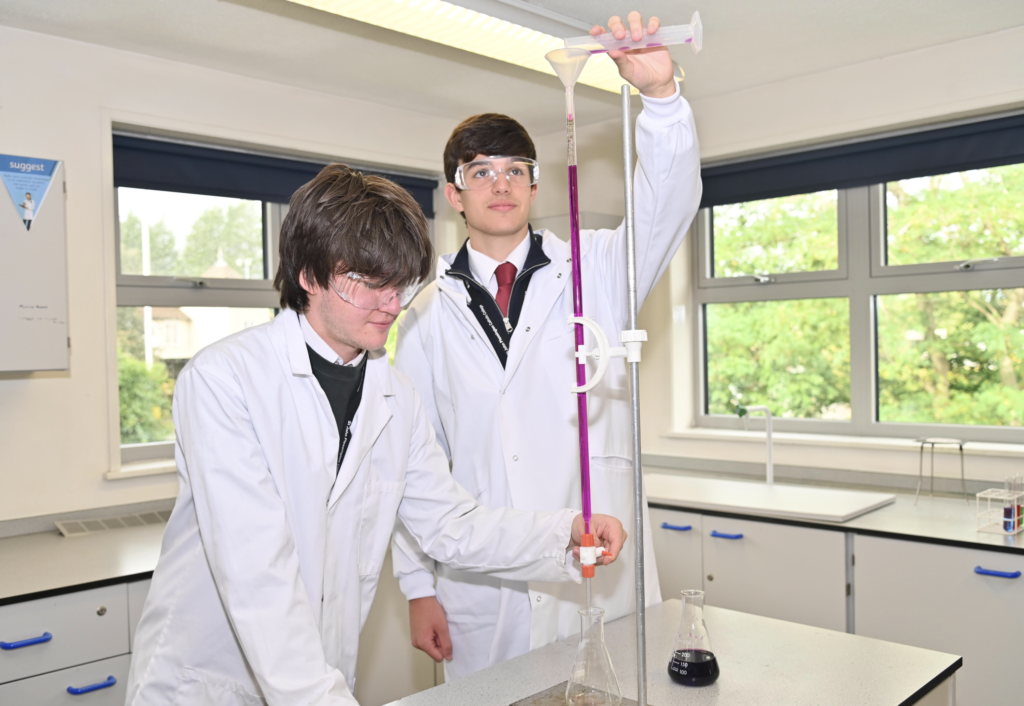
You will gain a challenging and fascinating insight into the building blocks of our planet. Starting with the structure of atoms and how they bond together, the course covers many aspects of organic, inorganic and physical chemistry. The practical aspects of the course will develop your analytical skills using a range of chemicals and high-precision equipment.
What you'll explore
Discover the knowledge and skills you'll develop throughout this course.
- Physical Chemistry (atomic structure, amounts of substances, bonding, energetics, kinetics, chemical equilibria and Le Chatelier’s Principle
- Inorganic Chemistry
- periodicity
- Group 2 Alkaline Earth Metals
- Group 7(17) The Halogens
- Organic Chemistry
- alkanes
- halogenoalkanes
- alkenes
- alcohols
- organic analysis
- Inorganic Chemistry
- properties of Period 3 elements and their oxides
- transition metals
- reactions of ions in aqueous solution
Course Content
First Year of A-Level
Physical Chemistry (atomic structure, amounts of substances, bonding, energetics, kinetics, chemical equilibria and
Le Chatelier’s Principle).
Inorganic Chemistry (periodicity, Group 2 Alkaline Earth Metals, Group 7(17) The Halogens).
Organic Chemistry (alkanes, halogenoalkanes, alkenes, alcohols, organic analysis).
Second Year of A-Level
Physical Chemistry (thermodynamics, rate equations, equilibrium constant for homogenous systems, electrode potentials and electrochemical cells).
Inorganic Chemistry (properties of Period 3 elements and their oxides, transition metals, reactions of ions in aqueous solution).
Organic Chemistry (optical isomerism, aldehydes and ketones, carboxylic acids and derivatives, aromatic chemistry, amines, polymers, amino acids, proteins and DNA, organic synthesis, NMR spectroscopy, chromatography).
Entry requirements
For Level 3 study, students generally need five GCSEs at grade 4 or above, including English or Mathematics. Course-specific requirements must be confirmed by the Sixth Form team.
How you'll be assessed
Explore examination papers, coursework and practical assessments.
Assessment breakdown
Assessment
As with Physics and Biology, Chemistry is taught as a linear course that is assessed by examinations in June at the end of Year 13.
Paper 1: Physical Chemistry and Inorganic Chemistry, including relevant practical skills.
Examination - 2 hours
35% of the overall A Level Marks
Paper 2: Physical Chemistry and Organic Chemistry, including relevant practical skills.
Examination - 2 hours 35% of the overall A Level Marks
Paper 3: Any content and any practical skills.
Examination - 2 hours 30% of the overall A Level marks
Paper 3: Topics 1 - 8, including relevant practical skills, critical analysis of given experimental data and one essay question. Examination - 2 hours 30% of the overall A Level Marks
Where could Chemistry take you?
Explore further study, career opportunities and the skills this subject can develop.
Progression Route
Chemistry is highly regarded and considered a ‘facilitating subject’ for the top universities in the country, regardless of the degree that you wish to study. It provides an excellent grounding for those wishing to progress onto Law and other traditional ‘humanities’ subjects but also for Medicine and Veterinary Science as well as Business or Management.
Chemistry is a good choice for students looking to progress into careers involving Health, Research or Industry. These may include professions such as Medicine, Dentistry, Veterinary Science, Education, Forensic Science, Biochemistry, Chemical Engineering, Pharmaceutical Research and Development.
Additional course information
Is there anything else I should know?
You will develop excellent practical and problem solving skills and the course will prepare you for a wide range of degree courses and careers in Science.
Your next chapter starts here.
Find your direction, discover your subjects and join SJP Sixth Form.